March, 1999
A Fireside Chat with
Quentin Crisp
Homosexual Extraordinaire
by Carlin Langley
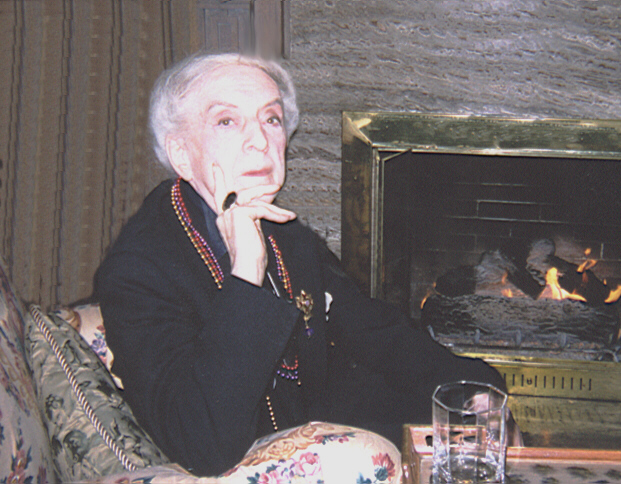
|
March, 1999 A Fireside Chat with Quentin Crisp Homosexual Extraordinaire by Carlin Langley |
|
After attending the sold-out performance, I had the opportunity to visit one-on-one with the 90 year old Mr. Crisp at the beautiful home of Dr. Prelutsky. Mr. Crisp commented, "I have never stayed in such a castle before. It's quite nice!" I thank Dr. Prelutsky for his hospitality.
Quentin Crisp is an icon. An icon is defined as "a sign whose form suggests it's meaning". One can tell by looking at him, that without a doubt, if indeed he is a man, then he MUST be gay. Quentin Crisp has been more effeminate than masculine since he was a young man. Quentin Crisp was born on Christmas day in 1908, and was sort of like a "Boy George" of the 20's. More recently, he has portrayed Queen Elizabeth in the film adaptation of Virginia Wolf's Orlando and played Lady Blackwell in the stage version of The Importance of Being Earnest. He was also in Philadelphia, The Bridge, To Wong Foo, and Camp Christmas.
I asked Mr. Crisp, "What was it like being an "out" gay man in the early part of the 20th century?" He replied: "Well, you see, my sin was not really my homosexuality, because people didn't really believe in it. My sin was my effeminacy. You see, we thought that all homosexual men were effeminine. I thought that the whole world thought it, because that was the only people you could see. But of course, I now know differently. And now in America, effeminacy is frowned on, and in England too, to some extent. There was a wonderful man called Larry Grayson, who was an England televisionary. A delegation of homosexuals went and implored him not to be so effeminate, but of course, he wasn't being effeminate, he was only being himself. You see, women are not really approved of in England. Men don't like effeminate WOMEN, much less, effeminate men. They'll say, 'Oh she's always touching up her appearance and asking what I think of her.' Americans expect that. The attitude of Americans towards women is quite different. You see, Americans call their girlfriend, "Sugar", or "Honey", or "Baby". An Englishman calls his wife "Old Girl". Who wants to be an "Old Girl"??? They're shuffling off the idea that women are female or effeminate in any way. So I was not approved of and I don't think any of my friends were. I went and sat in West End cafes with all the other boys who wore makeup and who swished about the West End, and we pooled our misery. Now that I'm older, I know that half their misery was self-induced. They explained that they got turned out of their digs, but I now know they got turned out because they invited men back who opened the gas meter. They complained they lost their jobs because they were effeminate, but I now know they insisted on dancing the polka around the shop floor with the shop stewards and things like that. But their plight touched me, and I decided that, the only way to deal with it, was to BE it. You see, if you write books about homosexuality, they are only read by homosexuals. If you put on plays or films about homosexuals, they are only seen by homosexuals, and by liberals who want to be seen going into the cinema and coming out. But if you LIVE IT, then everyone has to see it. And so I thought, they would all see me and would say, 'Well, there's one! He's not doing much harm. Just fetching his laundry.', or whatever I was doing. And so that's what I did. And the effect was disastrous. I had to live in the poorest part of London, because I had no money. And there, I was attacked almost every night when I went home. You see, not attacked by one person, but by several people, so it's useless to defend yourself. Well, except with a gun, which I couldn't get." I asked him, "Attacked in what manner, Quentin?" "Oh, physically... physically they ganged up on you and they beat you up, and they left you lying on the pavement and that, I think they felt was enough. They had somehow established their ascendancy, their dominion over you, and their masculinity. So that's the kind of life I had and it was frowned upon by real people, but also by homosexuals, who didn't want the world to think that homosexuals were effeminate or people who swished about London in the middle of the night with makeup on. It was all regarded as very questionable. It was a risky life, but I had to live it."
Next question, "How does being gay make your life different from the average 90 year old man today?" "Well, my life now, in America is different because in America, everybody is your friend. An Englishman met me once and said to me, 'You're the one who lives here permanently now aren't you?' And I said, yes... And he said, 'Well, why???' And I said, 'Because everywhere I go, everyone talks to me.', and he said, 'I can't think of anything worse!' Because English people don't like to be talked to by strangers. See, you get on a bus in England and you say aloud, 'I've been waiting hours for this bus!' and the person next to you looks at you and says, 'Do I know you?' But in America, if you get on a bus you can get the whole bus talking about one subject, like a school outing. It's wonderful."
Next question, "In your ninety years, what's the most significant event that you've experienced?" His response, "Oh, coming to America, easily. You see, I came here the first time because I was invited by Mr. Bennett, who wanted to make my life story into a musical, which I would have loved. But my agent said it was not to be, and it was never done. And I went back to England, and was sold into slavery to a Mr. Elkins, who was an impressario, who discovered people, he processed them, he packaged them, and he marketed them. And he did this very kindly for me." I interrupted, "When was it that you came to America for the first time?" "I came to meet Mr. Bennett in 1977, I came to work for Mr. Elkins in 1978, and worked on McDougal Street, which is on the fashionable side of the island, and in Los Angeles in 1979, and then I was abandoned and returned to England, but I had seen America and I wanted it. So I packed my possessions in a little red handkerchief and tied them to the top of a stick, and came back to America. And I've lived here ever since. Of course, it was a terrible risk because I was already 72 when I got here so I couldn't apply for a job. But I've never worked in all the time I've been in America, nearly eighteen years. I've relied like Madamoiselle DuBois, on the kindness of strangers."
Our Fireside Chat with Quentin Crisp continues. <<--CLICK HERE