November, 1999
A Legend Passes On...
Quentin Crisp, dead at 90
by Carlin Langley
|
November, 1999 A Legend Passes On... Quentin Crisp, dead at 90 by Carlin Langley
|
|
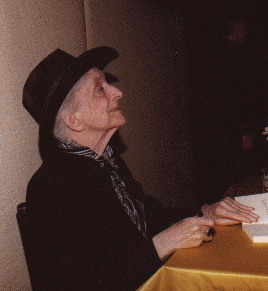
St. Louis was privileged to have hosted, through the auspices of Joan Lipkin and that Uppity Theatre Group, a living legend last March, for what has turned out to be, one of his last public performances. Sunday, November 21, in his native England where he had traveled to begin his last performing tour in his home country, Quentin Crisp slipped peacefully into eternal slumber, taking from us, one of the noblest, sharpest wits this century has seen.
Joan Lipkin, who brought Quentin's one-man-show to St. Louis' audiences, had this to say about Quentin's passing. "In a time when even Gap ads emphasize conformity, it is reassuring to think of the splendid individuality of Quentin Crisp. Through the example of his life and his many books, he had much to teach us about courage and being true to one's self, and although he was persecuted for much of his earlier life, in the end, he triumphed. So fierce was his belief in his right to live his own life, Quentin had a remarkable effect on almost everyone who met him. He projected love and acceptance, and thus, drew it to himself. I'm proud to have been able to call him my friend if all too briefly and grateful that so many of us in St. Louis could bask in his wisdom and glow at the St. Marcus Theatre just a few months ago. Rest well, you dear old queen."
Quentin Crisp endured more mistreatment, more abuse, and more "gay bashing" than anyone should have to experience in a lifetime, but he was also on more talk shows, had met more celebrities, and had more opportunities than most people could squeeze into a lifetime as well! I asked Mr. Crisp, "What was it like being an "out" gay man in the early part of the 20th century?" He replied: "Well, you see, my sin was not really my homosexuality, because people didn't really believe in it. My sin was my effeminacy. So I was not approved of and I don't think any of my friends were. I went and sat in West End cafes with all the other boys who wore makeup and who swished about the West End, and we pooled our misery. Now that I'm older, I know that half their misery was self-induced. They explained that they got turned out of their digs, but I now know they got turned out because they invited men back who opened the gas meter. They complained they lost their jobs because they were effeminate, but I now know they insisted on dancing the polka around the shop floor with the shop stewards and things like that. But their plight touched me, and I decided that, the only way to deal with it, was to BE it. You see, if you write books about homosexuality, they are only read by homosexuals. If you put on plays or films about homosexuals, they are only seen by homosexuals, and by liberals who want to be seen going into the cinema and coming out. But if you LIVE IT, then everyone has to see it. And so I thought, they would all see me and would say, 'Well, there's one! He's not doing much harm. Just fetching his laundry.', or whatever I was doing. And so that's what I did.
I asked him, "What's your regrets that you look back upon?" He replied, "Well, I don't think I can really regret anything. I've always said, "You can only regret something, if you had alternatives, if you could have done otherwise." But I did the only thing I was able to do. Really, I was a hopeless case. Now, I've come to America, and I've become a sort of "national hero" but why, I don't know! Because I did the only thing I could do, which is, be myself. You see, even the boys who liked me in school said, "You have to stand like that. Put your hands down." They were trying to teach me to make like a school boy. I never learned. And then, of course, in the end, the moment comes when you do deliberately what you used to do by mistake because you're fed up with doing it badly, and that's a remark that is made in Philip O'Connor's book, "The Memoirs of a Public Baby". He says, "The time comes for everybody when he has to do deliberately what he used to do by mistake, and then the joke becomes your own."
I am privileged to have spent 45 minutes alone with this wonderful man, and mourn his passing. Anyone who would like to know more about Quentin Crisp and how he blazed the trail for the gay rights we have today can visit his website at www.quentincrisp.com where you can sign up for a free email account with a "name@quentincrisp.com" address as well as to receive a free Quentin Crisp Lapel Pin for you to proudly proclaim, "I identify with this legend of a man, Mr. Quentin Crisp."